
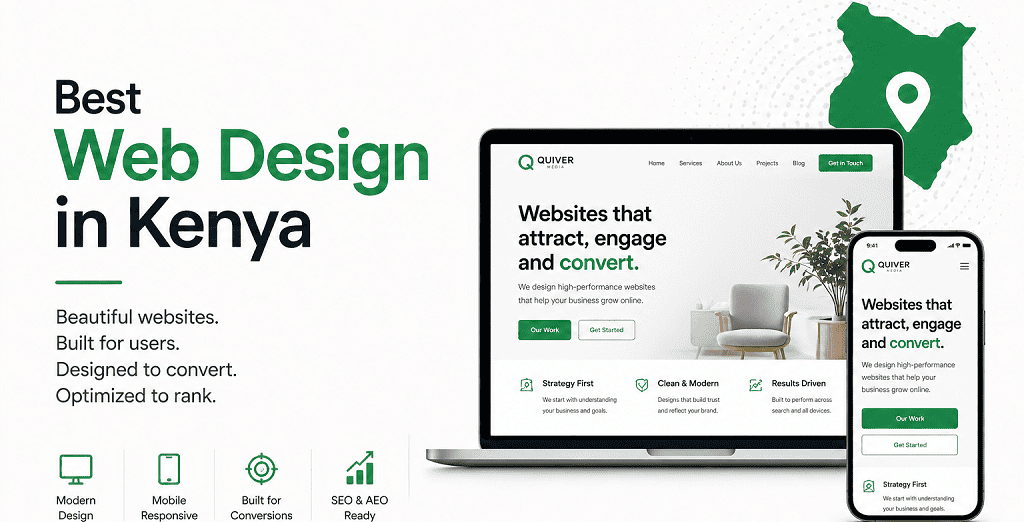
Web design in Kenya should do more than give your business an online presence. Instead, it must attract the right audience and guide them toward action. In Kenya, many businesses invest in websites that look acceptable but fail to perform. These websites often lack structure, clarity, and alignment with how people search online. As a result, visitors land on the site but leave without taking action.
This gap creates a serious problem. Visibility alone does not translate into business results. When the structure is weak, search engines struggle to understand the site. At the same time, users struggle to trust it. Because of this, traffic becomes inconsistent and unreliable. Over time, the website stops contributing to growth.
At Quiver Media, we approach web design differently. We focus on building systems rather than static pages. Each website is structured to support search visibility, clear communication, and customer conversion. In addition, we align content with real user intent instead of assumptions.
Ultimately, the goal is not just to exist online. The goal is to create a platform that consistently attracts, informs, and converts visitors into customers.
What web design should actually do
A high-performing website must serve a clear business purpose. First, it should help your business appear for relevant searches. This requires strong SEO foundations and proper page structure. Without this, even a good-looking website will struggle to gain visibility.
Next, the website must communicate your offer within seconds. Visitors should quickly understand what you do and who you serve. In addition, the site should build trust through clear messaging and credible presentation. If this step fails, users leave before engaging further.
After that, the website must guide users toward a clear action. This could be a call, enquiry, booking, or purchase. However, many websites fail at this stage. They provide information but do not direct the user.
Therefore, design alone is not enough. Structure, clarity, and flow matter more than appearance. When all elements work together, the website becomes a reliable business tool.
Our approach to web design in Kenya
Every project begins with understanding the business and its market. Instead of focusing on design first, we analyse how customers search and make decisions. This includes identifying key services, locations, and expectations.
From there, we structure the website around real search intent. Each page is designed to answer specific questions clearly. In addition, content is written to match how people search online. This improves both usability and ranking potential.
We also plan internal linking carefully. This strengthens authority across the site and improves navigation. Furthermore, we integrate SEO and AEO from the beginning. This ensures the website performs in both traditional and answer-based search.
As a result, the website becomes part of a complete digital system. It supports visibility, builds trust, and drives action consistently.
Why do many websites in Kenya underperform?
Many websites struggle because of a weak structure rather than a lack of effort. Businesses often focus on design without considering performance. As a result, pages lack a clear purpose and direction.
Content is often too broad and unfocused. Headlines sound polished but say very little. Because of this, users struggle to understand the offer. At the same time, search engines struggle to interpret the content.
Another common issue is poor integration. Design, SEO, and content are handled separately. This creates inconsistency across the website. Over time, fixing this becomes more difficult and expensive.
Therefore, the problem is not effort but structure. When the foundation is weak, everything else becomes less effective. Fixing structure changes how the website performs.
Built for businesses that need customers
Our approach works best for businesses where visibility drives revenue. Service businesses depend on local search and quick decisions. Real estate companies rely on structured pages and location relevance.
Hospitality businesses need strong presentation and booking flow. E-commerce stores benefit from organised categories and clear product structure. In addition, professional services need credibility and clear communication.
Although industries differ, the principle remains the same. The website must reflect how the business gets customers. Therefore, we design each site around real customer behaviour.
As a result, the website becomes easier to understand and trust. This improves engagement and increases enquiries over time.
Web design in Kenya with local awareness
Search behaviour changes depending on location. For example, competition in Nairobi differs from that in Nanyuki or Kisumu. In addition, user expectations vary across regions.
Because of this, location must be part of the website structure. We do not add it later. Instead, we integrate it from the beginning. This ensures the site aligns with real search patterns.
We also design for businesses targeting multiple regions. This includes Uganda, Tanzania, and South Sudan. As a result, the website can support both local and regional visibility.
This approach allows the business to grow without restructuring the entire website later.
SEO and AEO should not be added later
Many businesses treat SEO and AEO as separate steps. They launch the website first and fix visibility later. However, this approach creates long-term limitations.
When SEO is not built into the structure, ranking becomes difficult. Similarly, ignoring AEO reduces visibility in answer-based results. Therefore, both must be included from the start.
This improves page hierarchy and content alignment. In addition, it helps search engines understand the site better. As a result, the website performs more consistently over time.
A website should not simply exist online. It should actively support business growth every day.
What a well-built website gives your business
A well-structured website creates long-term value. First, it improves visibility in search results. This brings more relevant visitors to your site.
In addition, it builds trust before any interaction. Visitors understand the offer quickly and feel confident. As a result, they are more likely to take action.
Over time, the website supports consistent lead generation. It also reduces reliance on paid advertising. Organic traffic becomes more stable and predictable.
Ultimately, the website becomes a core business asset. It works continuously to support growth.
Build the foundation properly
If your website is not generating enquiries, the issue is rarely design alone. In most cases, the problem lies in structure and clarity.
Improving the foundation changes how users and search engines interact with your site. This leads to better visibility and stronger engagement. In addition, it creates a clearer path for action.
Over time, this results in more consistent enquiries. Instead of short-term fixes, it builds long-term value. This is where real growth comes from.
Tell us about your business and your goals. We will help you build a system that works.
FAQs About Web Design in Kenya
- What is web design in Kenya focused on today?
Modern web design focuses on structure, clarity, and performance, not just appearance. - How much does web design cost in Kenya?
Costs vary depending on features, complexity, and level of customisation. - How long does it take to build a website?
Most projects take between two and six weeks, depending on scope. - Why do many websites fail to generate leads?
They lack structure, clear messaging, and proper search alignment. - What is the role of SEO in web design?
SEO helps your website appear in search and attract relevant traffic. - What is AEO, and why is it important?
AEO helps your content appear as direct answers in search results. - Can I improve my current website instead of rebuilding?
Yes, but only if the structure supports improvement. - Do I need a mobile-friendly website?
Yes, most users browse on mobile devices today. - How does location affect website performance?
Location improves relevance in local search and visibility. - What makes a website successful?
Clear structure, strong messaging, and alignment with user intent.
Conclusion
Web design in Kenya is no longer about creating an online presence. It is about building a system that supports visibility, trust, and growth. As search behaviour continues to evolve, businesses must adapt to remain competitive.
A well-structured website improves how users understand your offer. It also helps search engines rank your pages effectively. This leads to better visibility and more consistent traffic.
Over time, the website becomes a reliable source of enquiries. It reduces dependence on paid marketing and supports long-term growth. However, this only happens when the foundation is built correctly.
At Quiver Media, we focus on building websites that perform. We combine design, SEO, and AEO into one system. If you want real results, the structure must come first.