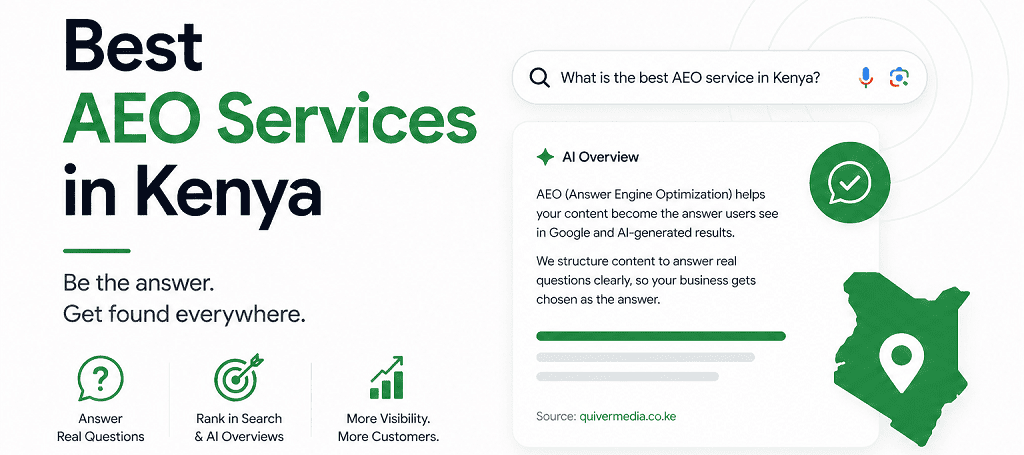
AEO services in Kenya are becoming essential for businesses that want to stay visible in modern search results. Over the past few years, search behavior has changed in a quiet but important way. People no longer browse through many websites before making a decision. Instead, they expect direct answers that help them act quickly and confidently. This shift has changed how platforms like Google present results to users across different devices and locations.
Today, search results often include summaries, quick answers, and highlighted responses that reduce the need to click. As a result, many websites still appear in rankings but receive little attention from users. This happens because their content does not clearly answer the questions people are asking. In contrast, well-structured content is easier to extract, understand, and present as a trusted response.
Because of this shift, businesses must rethink how they build their websites and content. It is no longer enough to exist online with basic pages and general descriptions. Instead, every section must communicate clearly, answer specific concerns, and guide the reader toward a decision. This is where Answer Engine Optimization becomes relevant. It focuses on clarity, structure, and usefulness, rather than volume or repetition.
What Answer Engine Optimization Actually Involves
Answer Engine Optimization is not a trend or an additional service layered on top of SEO. Instead, it is a structural approach to content that ensures your website communicates clearly to both humans and machines. At its core, AEO removes ambiguity and replaces it with clarity that can be understood instantly. When a potential customer asks a question, your content should respond directly with enough depth to satisfy both the reader and the system interpreting it.
For example, instead of writing broad statements about services, AEO requires context, explanation, and usable detail. If someone searches for pricing, they expect a range or breakdown that helps them decide. Similarly, if they search for a process, they want to understand how it works from start to finish. This level of clarity allows your content to appear in featured snippets and AI-generated answers from tools like ChatGPT.
Why Businesses in Kenya Struggle With Visibility
The challenge in Kenya is not a lack of effort, but a lack of structure. Many businesses invest in websites and digital presence, yet few invest in how that content communicates. As a result, pages are filled with general statements that do not answer specific questions. From a user’s perspective, this creates confusion and slows decision-making.
Search engines, however, are designed to reduce confusion and deliver certainty as quickly as possible. When multiple websites exist, they will always choose the one with the clearest and most direct answer. Therefore, structure becomes more important than volume or design. This explains why smaller websites can outperform larger ones when their content is better organized and easier to understand.
The Shift From Ranking to Selection
For years, SEO success depended on where a page ranked in search results. Being on the first page was enough to generate traffic and leads. However, search engines now aim to resolve user intent immediately without requiring multiple clicks. This means extracting key information and presenting it directly within the results.
As a result, the competition has shifted from ranking to selection. A page that is selected as the source of an answer will outperform several pages that simply rank below it. Therefore, the real goal is no longer visibility alone, but usability. Businesses must ask whether their content can be used as the answer, not just whether it can be found.
How We Approach AEO at Quiver Media Ltd
At Quiver Media Ltd, AEO is built into how content is planned and structured from the beginning. The process starts by understanding how customers think and what they need before making decisions. Instead of relying only on keywords, the focus shifts to identifying real questions, concerns, and comparisons.
Once this understanding is clear, content is structured to respond logically and directly. Each section answers a specific aspect of a broader topic, creating a flow that is easy to follow. In addition, unnecessary complexity is removed to ensure clarity remains consistent throughout the page. This makes the content more useful for readers and easier for search systems to interpret.
How AEO Connects With Local Search in Kenya
Location plays a major role in how search results are delivered, especially for service-based businesses. When someone searches within Kenya, the system considers both topic relevance and location context. Therefore, content must reflect not only what a business offers, but also where it operates.
We integrate location naturally into content by aligning it with real search behavior. Instead of forcing keywords, we structure information so that relevance is clear and consistent. Platforms like Google Maps also rely on structured data to determine visibility. When content aligns with both topic and location, it performs better in local search results.
The Difference Between Informative and Usable Content
Many websites contain information, but not all information is useful in a practical sense. Informative content often explains concepts without helping users make decisions. In contrast, usable content provides clarity, direction, and context that supports action. This distinction is important in AEO because search engines prioritize content that resolves intent.
For example, a user deciding between repair and replacement needs more than a service description. They need factors, comparisons, and possible outcomes to guide their decision. When content addresses these directly, it becomes more valuable and more likely to be selected. This value is recognized by both users and search systems.
What Businesses Gain From AEO
When AEO is implemented correctly, the effects become visible in both traffic quality and user behavior. Visitors arrive with a clearer understanding of what to expect, which reduces hesitation and builds trust. As a result, interactions become more meaningful and conversion rates improve.
Over time, businesses also reduce reliance on paid advertising. As content begins to answer real questions consistently, it attracts organic traffic that is already aligned with the service offered. This creates a more stable and sustainable flow of leads, especially in competitive markets across Kenya.
FAQs
What is AEO, and how is it different from SEO?
Answer Engine Optimization focuses on structuring content so that it can be selected as a direct answer. While SEO focuses on rankings and visibility, AEO focuses on clarity and usability. Therefore, AEO helps content appear in featured snippets, summaries, and AI-generated responses. Both approaches work together, but AEO reflects how search systems currently operate.
Why are many Kenyan websites not performing well in search?
Many websites in Kenya still rely on general content that does not answer specific questions. As a result, search engines struggle to extract useful information from these pages. This leads to lower visibility in answer-based results. When content lacks structure and clarity, it becomes less competitive regardless of design or effort.
Does AEO replace SEO completely?
AEO does not replace SEO, but it builds on it. SEO helps your website become visible, while AEO ensures your content is selected and used. Therefore, both are necessary for strong performance in modern search. Ignoring either one limits your ability to reach and convert users effectively.
Who benefits most from AEO services in Kenya?
Businesses that rely on search for leads benefit the most from AEO. These include service providers, real estate companies, healthcare professionals, and retail businesses. If customers ask questions before choosing a service, AEO becomes highly valuable. It helps position the business as a trusted source of information.
Conclusion
Search is moving toward faster answers, clearer information, and higher trust in selected results. As this shift continues, businesses must adapt to remain visible and competitive. AEO provides a structured way to align content with how search systems and users interact today. Instead of focusing only on presence, it focuses on usefulness and clarity.
In Kenya, this creates a strong opportunity for businesses willing to improve how they communicate online. Many competitors have not yet adapted to this approach, which leaves room for well-structured content to stand out. By focusing on real questions and clear answers, businesses can build trust before direct interaction even begins.
Ultimately, AEO is not about adding more content, but about improving how content works. When information is organized, relevant, and easy to understand, it becomes more valuable to both users and search systems. This leads to better visibility, stronger engagement, and more consistent results over time.